2012 Rocky Mountain Camping Trip
"On a Greyhound thirty miles beyond Jamestown
He saw the sun set on the Tennessee line
He looked at the young man who was riding beside him
He said 'I'm old, kind of worn out inside’”
– Minutes to Memories by John Mellencamp
On June 1st of 2012, at 47 years old and already disabled, I took a solo, 63-day camping, photography and writing trip, driving thousands of miles through the spectacular Rocky Mountains in blooming summertime, living in the rugged outdoors – at one point spending 47 days straight in one of my little tents, 41 of those in grizzly bear woods – taking thousands of photos, while challenging the heck out of my failing body and probing weighty issues deep inside for some much-needed resuscitation of spirit. This is the story of that magical and ultimately life-altering adventure.
"All I wanna do is have a little fun before I die."
– All I Wanna Do by Sheryl Crow

Me and my new-to-me sports car, a 1991 BMW 850i, in Queens, New York, on November 11, 2011
Introduction
Kenny (and That Damn Car!)
“I'm a traveling man don't tie me down
There's just too much living going all around
A man he's got to see what he can see”
– Give Back My Heart by Lyle Lovett
Before I share the story of my 2012 road trip, there are a couple of things you need to know about me. First off, I'm a primitive backcountry camping and hiking nut and have been in love with exploring the Rocky Mountains ever since I first drove out there for a ski trip in 1986. And, I've not only gone camping and backpacking in incredible backcountry places, like my favorites, the Utah national parks, but, I've also collected quality, lightweight gear over the years that allowed me to continue in this love of mine on this trip, even through my disabilities that severely impacted my walking and carrying capabilities.
The other thing to know is that I'm a sports car enthusiast and have been ever since I got my first Camaro at 15-years-old, as I just love anything that goes fast and makes noise. And, ever since I first drove through the Rockies, I'd always wanted to have a bad-ass sports car with which to confront the mountain roads. In late 2011, I finally got that car: a rare, 1991 BMW 850i with a V12 engine, BMW's only self-labeled "supercar" which could do 186 mph from the factory. And, this wasn't just my base dream car either as it was souped-up with tons of aftermarket performance upgrades for the engine, transmission, suspension, braking, wheels and exhaust; in other words, it perfectly fit my definition of "bad-ass," especially once I got my heavenly-sounding McIntosh/CDT stereo installed and thumping.
So, now to answer the question of why is my darn car in so many of these location photos?? First off, it's because, due to my handicaps, I did a lot of car camping on this trip with my tent site within a short walk from my car, so, my black beauty was usually "right there" when I took site documentation photos.
Mainly though, it's because I had planned to write a blog of my trip on a website dedicated to the old BMW 8-Series, sharing about me challenging the heck out of that car on the curvy, mountain roads and also taking it to some insane, deep-woods backcountry locations – this page here kind of serves as that story – and that sports car is part of the narrative of the excitement I had and challenges that I faced on this trip. So, please excuse my love of this 850i as I'd wanted one since they first came out 20 years prior and I couldn't believe I actually owned such a nice one with which to attack the enticing mountain roads. Yeeha!
Leaving Mississippi
"You go back, Jack, do it again
Wheel turnin' 'round and 'round"
– Do It Again by Steely Dan
When I came up with the idea of returning to the Rockies for this trip, I realized that if things worked out with shipping on some new gear I'd ordered from my favorite store, REI, I should be able to get packed and leave on June 1, which was quite appropriate seeing that it would have been my baby brother Jean's 36th birthday and that so much of the trip was to try to find some beauty and tranquility in the mountains to feel safe to privately reminisce and write about him as a way to deal with his suicide, three years prior.
And, through days of exhausting organizing, weighing items and creative packing (and some inventive cussing), make it I did, as I left the house at the last second before midnight on Jean's birthday, turning out of the driveway with my sports car loaded to the gills with hiking, camping, photography and astronomy gear, and with my custom stereo pounding out Steely Dan – cranking Do It Again is a ritual, first song when I leave for adventures – as I settled into my hot rod for a long, long drive.
Yes, my mid-life crisis had begun …

Campsite on Bureau of Land Management desert backcountry outside Carlsbad Caverns National Park, New Mexico, on June 3, 2012
First Stop: The Desert
“No plan survives contact with the enemy.”
– A Rising Thunder by David Weber
In mapping out the trip with my old, paper atlas – I vowed no electronics! – I did have some small goals I wanted to hit and specific places that I wanted to see along my route, but I wasn't firmly set on anything else and, once I hit the road, I mostly just went in the direction of impulse, letting fate drive instead of over-planning it all as I had been wont to do in my life. I just knew that I needed to see the majestic Rockies again, to photograph them this time, and to have some cool campsites where I could find some solitude to think and feel and read and write.
With that in mind, I did plan my first stop because I wanted to visit the desert before I turned north into the mountains, as it had been 15 years since my last backcountry trip there, so I drove west for 20 straight hours to Carlsbad, New Mexico for my first night of camping on the trip (and there beginning my long string of nights sleeping on the ground in that tiny, Big Agnes tent or another slightly-larger, 3-man North Face I would buy a month later for a little extra room while car camping).
And, though the car was extremely well designed and comfortable in all the right places, my body still threw a fit on that long haul, as it was just murder on my hips and back sitting in one position for so long; I actually ended up stopping every couple of hours or so, whether the car needed gas or not, to just get out and stretch my legs for a bit and to try to take my mind off the pain.
With that going on, it definitely slowed down my drive to Carlsbad, and would do so my whole trip, so I arrived at Carlsbad Cavern National Park later than expected, right at dusk, and found the Park's campground was already closed for the night. Shoot, I'd have to find somewhere else to camp and do so in the dark, which is always difficult in unknown territory, and that surely wasn't an auspicious way to start my trip.
By the time I finally found a spot to camp in the Chihuahuan Desert outside the Park, I was so exhausted from organizing and packing and driving 1,000 miles straight and being up two days and dealing with my aches that, when I built my camp in the dark with only my little Petzl headlamp for light, on some remote Bureau of Land Management (BLM) territory I had found on my map, I didn't notice that the nice, pre-cleared area where I'd set up my tent and camp was actually a giant freaking ant bed – and these were nasty, T-rex-looking things who had rotten attitudes and meaner bites. Ouch, literally!
Whether from being too tired or sore or from lack of practice, as this was my first time setting up a camp in quite a while, I made a major backcountry mistake on that first night: I forgot to look out for the little things, as insects aren't called "pests" for nothing, and those prehistoric monsters were everywhere on the outside of my tent and gear – and I mean everywhere – forcing exhausting, detailed cleaning before I packed up and moved on so that I didn't transport any with me to an area they weren't indigenous. Living in the backcountry requires paying attention to even the smallest details and I'd pretty much failed my first night's test. Damn.
Note that, in writing about this adventure, I initially just wanted to celebrate the fun and wonder of the journey and share the pretty pictures and not go into anything bad that happened, as that was the "cheerful" celebration of life that I originally wanted to convey.
But, as I would discover while writing my story, this tale wasn't just about a happy-go-lucky road trip. No, not at all. As there was some serious heartbreak to face before, during and after this trip. And I now see that dealing with those emotions on my internal journey is more important than the journey on the road or that my feet took.
I say all of this because I have to admit that, as evidenced above by my contact with the Alien Vs Predator ants, not everything on this trip was bunnies and rainbows; heck, the main reason that I had left for this journey in the first place was to try to find some peace and beauty in the mountains to better deal with my brother's death, which was intensely hard enough in and of itself.
But, I hope that you will discover some inspiration, as I did from writing this, from the obstacles I faced inside and out and how I pushed through and dealt with them on this expedition of mine through the mountains and through my psyche.
With that in mind, I just have to say that the one night I spent in the wilderness outside Carlsbad was not an enjoyable one, and it had nothing to do with the desert. A couple of very tough things happened that are too lengthy to explain, here, and I remember lying in my tent that first night with just knots in my throat, like I took one in the gut. At that moment, I was unsure of what I had gotten myself into.
But, by sleeping on it and taking some time to calmly process my mistakes – by obsessively cleaning ants – and thinking about my next steps, I found that I was pretty determined to work through the emotional pain and physical hurdles I might – and did – face on this trip, no matter what life or Mother Nature threw at me; I just had to explore the Rockies with a camera before I died.
So, I decided to pack up and leave and put the bad voodoo behind me – and, somewhere in my camp, a tooth – and go ahead and head north for the mountains to do some photography to sooth my anguish, as the one good thing that did come out of that stop was that, when leaving the area, I ran into a fellow photographer/astronomer, who was a state ranger at Brantley Lake State Park where I went to fill up on water, and she was very knowledgeable and suggested to go check out both the Cloudcroft and Sunspot communities up in the mountains of south-central New Mexico and try camping in the Lincoln National Forest as it was alive and green and incredible.
So, I got in my hot rod and I put on some good, loud music to calm my screaming nerves to distract from my pain and I took off, ready for some different luck on the start of my adventure.

Straight up for the mountains or turn right for aliens??
After leaving the Carlsbad area, I saw this sign for Roswell, above, and thought it would be interesting to visit the geeky, alien-worshiping culture there, so I stopped to check my map, but I then reminded myself about something important with my desires and needs for this trip: I didn't want to do the normal "touristy" stuff; I just wanted to go to some remote campsites and try to take pictures of the wildlife and vistas in the mountains and to have some quiet and peace to read dear books and to write in my journal.
I had no desire for crowds, period, and I was going to go out of my way to avoid them, as I had even told myself that I wouldn't stop and take photos of bears or other creatures if a bunch of people were stalking the animal from the side of the road – I wanted to take National Geographic-quality pictures of creatures deep in the wild – and the best way to avoid people and to see cool critters was to find a remote, backcountry campsite deep in a national park or forest or BLM land, so I followed the state ranger's advice and I continued straight up on a short drive to the Lincoln National Forest outside Cloudcroft, New Mexico.

First campsite in Lincoln National Forest backcountry outside Cloudcroft, New Mexico, on June 3, 2011
The Mountains of New Mexico
"You just stay here in this one corner of the Forest waiting for the others to come to you. Why don't you go to THEM sometimes?"
– The House at Pooh Corner by A.A. Milne
My first stop in the Lincoln National Forest was to visit the ranger's office in the Sacramento Ranger District. Stopping and getting ranger advice first was a smart habit – plus, the rangers know the best campsites! – as you always wanted to find out about the weather conditions where you were going to camp and explore and, especially, know what wildlife you may run into. This was bear and cat country and you had to be smart.
All of my years of camping with some incredible backcountry leaders had fortunately taught me how to handle myself well out in the wild. And, despite my first, humbling, gap-toothed night in the desert, I must say that I still felt confident – yet not cocky, as that will get you killed out there – in being able to tackle the mountain forests by myself, even though this was my first, solo backcountry visit to the Rockies.
My initial campsite, up around 8,600' of elevation – yes, I was finally in the mountains again! – though easy to get to, was not exactly what I was looking for, as I was too close to a road and too cramped in views to get any good pictures. The only wildlife I saw was a small troop of mule deer does right around dusk and it was too dark and they were too far away for any photos. It was not a very exciting spot, so I packed up after one night and headed out to find something more remote, deeper in the national forest.

Second campsite in Lincoln National Forest backcountry outside Cloudcroft, New Mexico, on June 4, 2011
After spending a couple of hours driving around on some difficult roads, especially tough for my low-riding sports car, while checking out some other ranger-recommended sites, and while turning my car from black to dirt-road-dust brown, inside and out, I decided on the campsite pictured above and below, as it was exactly what I was looking for: a wonderful, open view in which to hopefully get to experience some wildlife ... and I would not be disappointed.

Second campsite in Lincoln National Forest backcountry outside Cloudcroft, New Mexico, on June 4, 2011
A Cat on the Hunt
“Everyone wants to be a lion. Most people just never get the chance.”
– Damian Lewis as Bobby Axelrod in Billions
The light-green pasture wedged between two pine-and-fur hillsides, at around 8,500' where I chose to make this new camp, looked like it would be a perfect spot to give me a nice view of anything that moved in this mountain's open valley. Free-range cows were not at the top of my wish list, but, here came a baker’s dozen of twelve adults and one baby, anyway, who showed up at dusk and spent over an hour or so eating, talking and making rude bodily noises – not quite National Geographic-caliber stuff, I must admit, yet, still entertaining as I lay there in my tent listening to them boisterously socialize after watching them move through my camp.
But, sometime right after dark set in, tension rang out in every direction in the moon-and-star-lit valley as the cows went from grazing in peace straight through scared and all the way to self-sacrificial before I even grasped the reality of their immediate danger: something was after their baby in the herd, and the adults would play chess with their lives before they gave up that little rook.
Jolting up in my tent and unzipping the mesh door to see better, I watched six of the adult cows encircle the calf and run off down the valley, but only as fast as the baby could manage (whose speed impressed me, nonetheless) and just run off wildly as a group they did not. The dance of life they performed was the most amazing ballet that I’ve ever witnessed as the six adults ran in a coordinated, counter-clockwise circle, centered on the calf, as they also ran away. This perpetual rotation kept the exposed gaps to the baby constantly moving and changing, designed to keep the hunter from the calf, and each cow was continually adjusting its distance to its closest partners as they ran to keep those vulnerable areas to a minimum.
While this was going on, the other half of the adult herd was disappearing in dust, as the six cows that didn’t run away performed a dance of their own: they jumped around in random motion creating a commotion by stomping and yelling, making a fog of escape for the other group with the baby, as they situated themselves between where I perceived the predator to be and the group of cows running away with the calf.
I’ve never heard of animals throwing dirt to the wind for caution’s sake before, but that is exactly what this second group was doing with their footsteps. These cows were putting something distracting between the hunter and its intended meal. And, through the diligence of both groups of elder cows, it worked. The cat left without an attack, solely because of the unselfishness of the twelve adult cows protecting their baby with their own lives.
It was the most amazing and beautiful projection of love that I’ve ever witnessed and I will never look at another “beast” as not being smart or emotional or loving. Those twelve cows defined devotion and intelligence with their protective behavior. They defined who we should strive to be.
Throughout the entire play that was acted out before me on that dimly-lit stage of green meadow, I never saw the cat. Never heard it. The dust-kicking group of cows was only about 100’ from my tent, yet they were near the edge of the forest, so the predator must have been right inside the line of trees, somewhere, hiding in the shadows, waiting for the right moment to attack – which never occurred – and it was forced to slink back into the darkness from whence it came, yielding to the cows, this time.
If I never had any sense of the cat, other than the behavior of the cows, why am I confident that it was a mountain lion that was on the hunt? Mainly I knew from talking to a couple of rangers and park service employees at the Lincoln National Forest Sacramento District Office a day or so later. They were fairly certain that it was not a bear, but, a mountain lion – most likely a recent mother looking for something large for her spring litter to feed on. I’m just glad that I was not the menu’s second choice when the first became fast food that got away.
And, the most introspective part of all that happened is that, a few hours after the failed attack was over, I awoke suddenly in my tent and could do nothing but laugh at myself as, within about 20 minutes after the mountain lion’s failed attempt at grabbing dinner, I had fallen sound asleep. The laughter came from the fact that I could sleep so well knowing that the hungry cat was out there, somewhere in the dark, and that it didn’t even bother me.
I found that it said a lot about me besides just the fact that I knew how to keep a safe campsite: I was stronger than I felt, which would be really important on the trails and of the trials of this trip. There I was in an open mountain valley with a hungry cat on the prowl – and I have no doubt that it knew I was there as they are unbelievably keen hunters – and I was in a two-pound, mesh tent with nothing to protect myself other than my hiking pole (which was actually outside my tent’s door, oops).
And seeing that I wasn't eaten that night gave me a bit of confidence that I would not be eaten at all on this trip, which I must say was an important goal of mine, so, yeah, I felt pretty good the next morning; not even a very large mule deer standing in the middle of the road during an audacious, speed-daring race down a mountain highway in my hot rod could faze me ...
A Run Down the Mountain
“Wind, in my hair
Shifting and drifting
Mechanical music
Adrenaline surge”
– Red Barchetta by RUSH
Before searching for my second campsite, I had taken a drive to explore Cloudcroft, New Mexico, a small, ski resort town in the Sacramento Mountains, and Sunspot, on top of one of the mountains where the National Solar Observatory (NSO) was located. One of the things I discovered is that the 18-mile drive going up the mountain to Sunspot from Cloudcroft was a mountain road-racer's dream; although the lack of guard rails in most places was pretty intimidating, I decided that it was my destiny to challenge that road with my heavily-modified "race car" coming back down that mountain.
And attack it, I did. I tested that crazy sports car of mine – and my driving skills – to see if I could double the speed limit in each section all the way down the mountain back to Cloudcroft. And, not only were my driving skills up to the task (or you wouldn't be reading this), but, the car performed better than I could have ever imagined; I had never driven anything that nimble and steady in my life, still giving me time to beg for forgiveness under my breath to the New Mexico authorities.
And, heck, not even a pulse-exploding incident with a huge, mule deer doe that was standing right slap in the middle of the two-lane road as I came hauling it around one corner, could dampen my spirits on that run; it happened so fast that she froze and I swerved and stayed in control and zipped by her and it was over before either of us idiots had time to think.
Though I'd much rather avoid wildlife on the road, as hitting something would break my heart, the quick reaction ability of that car is exactly why I felt comfortable racing it in the mountains. I found that not only did I never slide the car much, even though there was some loud complaining from the tires, but I never even once drifted out of my lane on that highway and crossed a road stripe (except briefly to get around the deer); the car would just plant itself into a corner and never give up, no matter how hard I seemed to push it.
And, yeah, doubling the speed limit means 90 mph in a 45 zone – and doing twice the limit was my minimum as I know I hit 100+ mph – and that's hauling the mail through the mountains and my car truly amazed and impressed me and I've had a lot of sports cars through the years. It was absolutely the thrill of a lifetime – a bucket-list item – putting that pulse-pounding sports car through its paces on that cool, curvy mountain road. And now I see why BMW labeled the old V12 850i as it's only ever "supercar." Holy cow, what a drive!
Another law-breaking admission: although I don't remember the maximum speed I hit on that winding "race track" in the Sacramento Mountains that day, I do know that it wasn't the highest of the trip, not even close. The evening I would move on from New Mexico and drive overnight to Grand Junction, Colorado, I found a very flat section of the New Mexico desert on a long, straight, two-lane highway in the abandoned time in the middle of the night, where my car begged me, saying that it needed to "run wild and free."
Since I had high-intensity headlights and fog lights in the car and with all of that blazing illumination I could see forever down that lonely, desert roadway that crystal-clear evening, I decided that it was an appropriate place to give my hotrod what it asked for and wind her up and see just how fast she really could go. And, I have to admit that I flattened the gas pedal and held on and let it rip and ... I chickened out ... before the car even started breathing hard (seriously).
The speed got to be too scary while thinking about some wildlife running out in front of me, as I could see antelope moving around in the desert off the sides of the road and I knew if I hit one or something else it would not only end them, but me too. Yet, I must admit that I still got that baby up to 165 mph and it handled it like a dream. Wow, that's the fastest I've ever driven a car in my life.
That thing was smooth as glass to drive and it had much more left that it wanted to show me, not even breathing hard, but my nerves wouldn't let me go any faster and I backed off. Still, what an unbelievably exhilarating "hochfrisiertes auto" as the German's would say (hotrod!) Of course, by admitting all of my speed-smashing adventures in their desert and mountains, I will probably never be allowed in the State of New Mexico, ever again. Which really stinks as it's interesting and varied and beautiful – at least what I saw fly by!

Entrance to the National Solar Observatory in Sunspot, New Mexico, on June 5, 2012
Sunspot and The National Solar Observatory
"When the moon is in the Seventh House
And Jupiter aligns with Mars
Then peace will guide the planets
And love will steer the stars"
– Aquarius / Let the Sun Shine In by The Fifth Dimension
Being such an astronomy lover – I was traveling with not one, but, two Meade telescopes crammed into my little car for the trip – earlier on the same day as my infamous mountain run I decided to tour the National Solar Observatory, which sat at the top of a mountain in unincorporated Sunspot, New Mexico. And, my walking tour of their site was very educational as I learned about the history of the different scopes in use there and I even got to go inside the main Sun observatory while live science experiments were going on – I was so close that I could have stuck my hand in the light beams being directed through prisms to different sensors – as the people there were all just astronomy and math and science geeks like myself and were more than happy to show off their cool toys.
It was truly interesting getting to see all of their work, but the best part of my visit was finding out the NSO was going to have a watch party, in two days, for the transit of Venus in front of the Sun, and they invited me. Seeing that this celestial event had only occurred just once in my lifetime before, in 2004, and that it would not be seen again until 2117 – long after my ashes have washed down from the Rocky Mountain’s streams all the way to the sea – I felt it was preordained for me to hang around the area long enough to attend.

Stargazers gathered at the National Solar Observatory in Sunspot, New Mexico, for the Transit of Venus, on June 5, 2012

Projected telescopic view of Venus transiting the Sun (bottom of image) at the National Solar Observatory in Sunspot, New Mexico, on June 5, 2012
Two days later, on June 5th, attending the watch party at the NSO was a very rewarding experience for this amateur astronomer as not only were we blessed to have perfect weather, but the turnout for the event was the ideal size, which meant there were plenty of people to get to socialize with, yet, everyone got plenty of time looking through the different scopes – after seeing the telescopes they had set up already when I got there I decided to leave mine in the car; no need embarrassing myself by someone saying to me, "Hey, that looks like a telescope, only smaller!"
I mean they had some really sweet and expensive scopes, old and new alike, and they couldn't have been more generous with their time and gracious with their information. It was quite intellectually fulfilling, as I met like-minded, educated people from all walks of life, from all over the Southwest, and we watched Venus slowly crawl across the Sun while speaking nerd for hours – this event was an unknown item on my bucket list that I got to happily check off.

Early morning drive through the mountains headed for the Colorado National Monument outside Grand Junction, Colorado, on June 6, 2012
The Drive to Grand Junction
"Off on your way, hit the open road
There is magic at your fingers
For the spirits ever lingers
Undemanding contact in your happy solitude"
– Spirit of the Radio by RUSH
After the star party and my down-then-up experiences in New Mexico on the first week of my trip, I decided that I wanted to move further north on my journey and go to one of the places that I had on my short list to see when I left for this trip: the majestic Colorado National Monument, outside Grand Junction, a town where I'd spent time in the 1990's when I actually had the good fortune to hike in the Monument in both summer and winter weather (it's extra magical covered in snow).
Yet, I had never gotten to camp down in the canyons inside and that was something I planned to fix on this trip. So, I pointed my hot rod north through the mountains on a long and spectacular, crystal-clear, night-and-next-morning drive through the mountains, jamming to the many, meaningful CD's that I had brought with me – including about twelve RUSH albums as, sorry guys, my spirit doesn’t do radio-quality sound! – and I headed towards west-central Colorado.

Ute Canyon campsite down in the Colorado National Monument outside Grand Junction, Colorado, on June 8, 2012
The Colorado National Monument
“Be careful don't go too deep
The climb back may be a bit steep”
– Inside Lookin’ In by Sammy Hagar
The camping that I'd done so far on this trip was all "car camping", which meant my campsite was within a short walking distance from where I parked. The Monument would be a challenging test totally different from that as I was going to pack down into Ute Canyon with enough supplies to camp for four days – true "backcountry" camping, which I'd not done in a long time.
That meant putting on my big, old, 60-pound (when loaded with food and gear), MoutainSmith pack, plus around four pounds of camera stuff and about eight pounds of water, for a total of about 72 pounds onto my surgically repaired and fused back and neck and my worn out hips. And then I was going to take all of that weight and hike down the canyon wall and eventually back out, a feat that I had no idea if I could actually accomplish, anymore.
In fact, I was filled with doubt as, although I was only planning to hike about one mile in on the trail to build my camp, the Ute Canyon trailhead began with a harsh, half-mile switchback which, in that short span, descended 650' down from the rim where I parked, into the base of the canyon. That's a particularly steep downgrade, and even rougher climb back out, and a hard trek for any healthy person with a full pack on, much less a serious matter of course for a disabled man.
The Ute Canyon switchback was demanding as can be when I hiked it with a small, day pack almost 20 years earlier – it's like going down and up the stairs of a 65-story building with all of that weight – and I truly had no idea if I could physically do it due to my infirmities, as my hiking was already unsteady with no pack on trying to walk on even ground – due to nerve damage and partial loss of control of my left leg – so saying it was risky (stupid??) is probably understating the issue by many factors.
But, I also knew that I was my typical self and stubbornly willing to try to endure whatever pain I would face for what I hoped would be a short-term struggle, as I really wanted to experience the Monument's beauty and enjoy its solitude for a few days. So, I made up my mulish mind that I would not be deterred and I would get down into that magnificent canyon somehow, someway, or die trying. At least I only had to survive going down and up one time each to get in and out ... or that's what I had assumed.
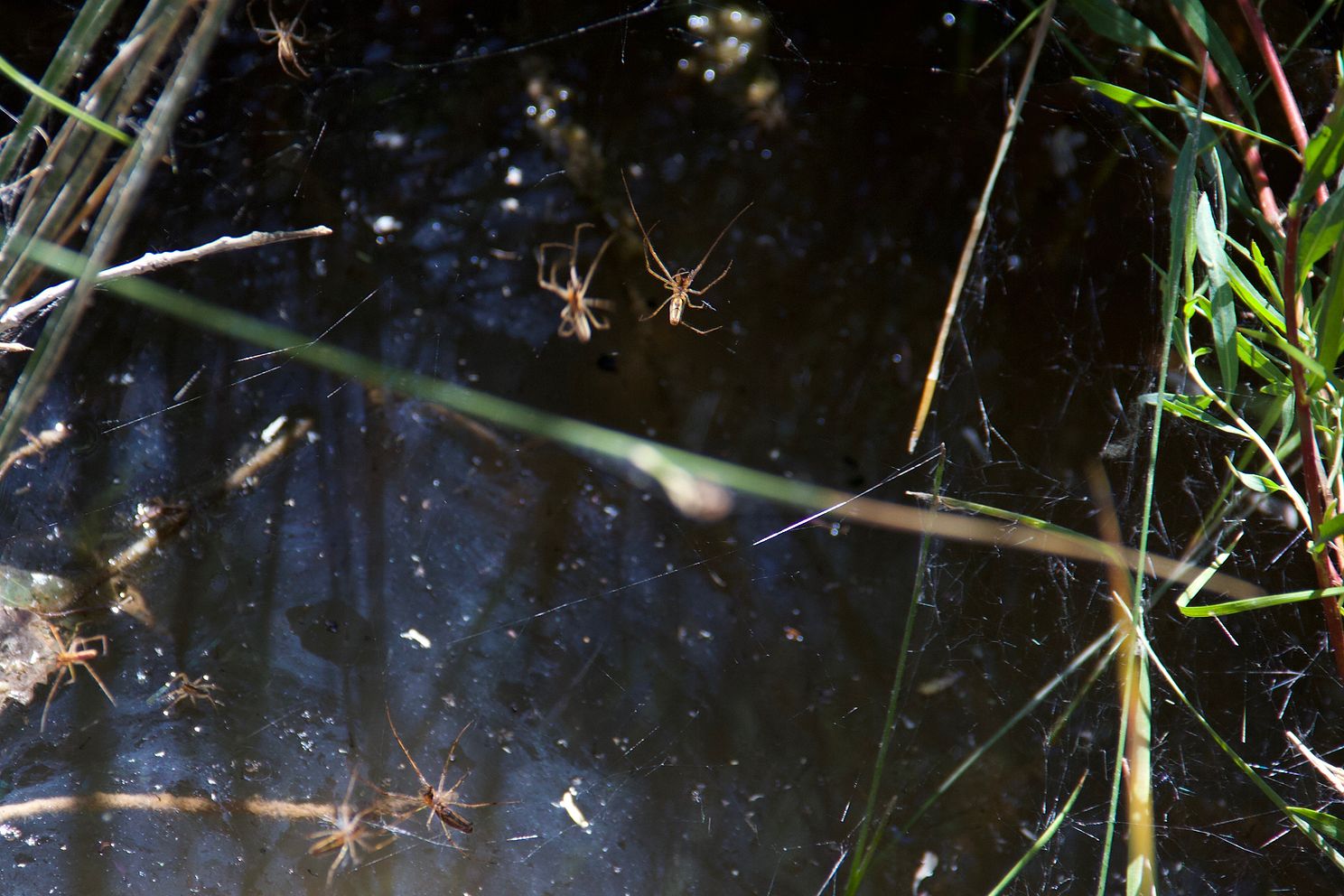
Spiders (I count 8) guarding a spring in The Colorado National Monument backcountry outside Grand Junction, Colorado, on June 8, 2012
While getting my backcountry pass at the park's office, I found out from my visit with the rangers that the entire park was under a red-flag, extreme-fire-hazard warning. The temps down in the valley would be over 100 F and there was very low humidity. Fortunately for fire conditions, the wind was low, yet that was going to be bad for me down in the breezeless heat of that canyon.
And while I wasn't too terribly worried about the temps, seeing how I grew up in the subtropics on the Mississippi Gulf Coast and have always been a Sun worshiper, I did find out some truly brutal news that would make this trip a heck of a lot tougher, to the point of almost abandoning it: due to the heat and dryness, campers – of which I was the only one in Ute Canyon – were not being allowed to use any of the natural springs in the canyon to filter to their water bottles, which I had completely planned on taking advantage of with my lightweight water-filter/pump.
The rangers told me that the natural springs were extremely low – and guarded by critters! as shown, above – and the water needed to be reserved for the canyon's local wildlife whose existence depended on those couple of springs. And, while this all made sense, it meant that every damn drop of water that I would need during those four days had to be packed in. My goodness.
Seeing that I would need around three gallons of water a day in that dry heat, which was also my water bottle and CamelBak capacity, I was going to have to climb up that rocky switchback and back down every single day, with my unstable body, fetching around 25 pounds of water from my car each trip, though with a much lighter backpack as only safety gear was necessary.
And, this didn't even take into account that I'd have to go down that first time with three gallons of water, instead of one, which brought my pack weight up to around 85 pounds for that initial trip down into the canyon and I just wasn't sure that was possible for me (again, the word "stupid" comes to mind).
This completely rotten news actually made me almost give up, very close to it in fact. Going down and up that 650' change of elevation once each way was difficult enough to face; doing it four times with my worn-out body seemed unfeasible.
Yet, with more of my legendary hard-headedness kicking in, along with my bitter distain for the word "impossible," I told myself that nothing was going to keep me from at least trying to experience the solace of the real backcountry again; giving up on it just didn't seem to be an option, even with the disabilities and pain that I was going to have to work around and through. So, I nervously took my backcountry pass, thanked the rangers and headed out to the waiting canyon.
I must say that going down that half-mile switchback was unbelievably difficult and required a tremendous amount of concentration on where I stepped and how it affected my balance – for every single step – so, I just took it really slow and took lots of breaks, which I believe were needed even more mentally than physically because it was pretty nerve-wracking maintaining that level of concentration, seeing how my life depended on it.
But, by doing it cautiously like that, I admit that the trek down into the canyon wasn't "quite" as bad physically as I'd feared and, even though I was weak and shaky throughout the entire descending hike, I never actually felt in danger of falling, which I've thankfully never done in the backcountry in my life.
Yes, I was incredibly exhausted, especially mentally, when I got down the canyon wall, but I would have time to rest in my camp and I thought that I would be okay and there was no permanent damage done on top of my normal pains.
For me this was quite an accomplishment as, when I became disabled, I never thought that I would be able to do a true, mountain backcountry trip again and my big pack had sat in the closet, unused, for a long time. So, accomplishing this goal made me ecstatic and feel alive again, no matter how weary I was nor how much I hurt from getting down into that canyon. Goodness, what an incredibly fulfilling feeling that I had missed in my life – and I could scratch off another bucket-list item.
Even though I love the rocks and colors down in that canyon, and the solitude was beautifully rewarding as I had time to read, think and write, the balance of my visit to Ute Canyon wasn't quite as exciting as I'd hoped, which was mainly because it was just so still and hot. Not a creature was moving, except for these hilarious lizards that liked to race me along the trail through the cottonwoods as I day-hiked in the base of the canyon (they always won!)
Seeing that there wasn't much to photograph, due to that stillness, and the fact that I didn't explore the canyon too far beyond my camp on my short day jaunts, being too tired from going up and down that canyon wall each day for my water, that I decided that after three days, instead of four, I was breaking camp and packing out. I'd had enough of the heat, there wasn't much to take pictures of and I'd spent as much time taking it easy and reading and writing as I could for one camp.
It was time to look for some cooler climes and, hopefully, some creature movement. Now, though, I just had to get my broken body back up to the canyon rim with that huge, full pack on my surgically-altered spine, which had, at the time, 12 pieces of titanium, two hunks of cadaver bone and a plastic wedge holding it together.
Tackling that hike back up that switchback was the hardest thing I've ever had to physically accomplish in my life – at least until later on my trip – even with about 20 pounds less in my pack due to some empty water bottles and food use. It felt achingly steep going up and was one of those situations that really did require one step at a time, constant self encouragement and extreme mental focus, as my steps just were not very confident seeing how weak and shaky my legs were.
And, it meant that every turn of the switchback – and I mean every, single turn – I had to stop and shift my hiking pole to the outside hand to get that extra stability for safety, as I had been taught, because I didn't necessarily feel secure even on straight parts of the trail due to the sharp incline.
But, by going extremely slow and stopping and resting a lot, I finally made it up that wall and back to my car on the rim. I was exhausted like I'd never been and I hurt seemingly everywhere and was so darn shaky I thought I'd vibrate the screws out of my spine. So, I just immediately dropped my big backpack on the ground and collapsed down in a heap next to my car in complete surrender to the fatigue ... but, maybe with the biggest, dumbest smile on my face that I may have ever had in my life.
I did it! I survived. I made it into and out of the Colorado National Monument again, by myself for the first time, and got to camp there and take pictures, something that only recently I had even dreamed of again. I don't think I've ever been more satisfied with myself and my backcountry skills, and I found incredible freedom from not letting my disabilities win and stop me from living and doing something interesting and fun again, which they had been doing for a while.
With that item checked off the bucket list, I decided it was time to find a place to rest – and to freaking cool off!

Road racer's dream route through the mountains in southern Wyoming on my way to Grand Teton National Park, Wyoming, on June 9, 2012
The Drive to the Tetons
"Everyday is a winding road
I get a little bit closer
Everyday is a faded sign
I get a little bit closer to feeling fine"
– Everyday is a Winding Road by Sheryl Crow
After climbing out of Ute Canyon that last time, I spent the night getting caught up on some desperately needed rest for my aches in the nearby Colorado River State Park, right outside Grand Junction, as I was just too fatigued to go any further; I didn't even pitch a camp and just put down my Thermarest sleeping pad and threw my sleeping bag on it and slept on top of them in the warm night and that was it – there is something magical and freeing to be said for sleeping that way so unencumbered under the stars.
When I got up the next morning, I took advantage of the showers and clothes washers at the park to clean up and reset, and I then set my sights on Wyoming, as another item on my bucket list was to see Jackson Hole and the Tetons.
So, I took off from west-central Colorado on what was another stunning and fun cruise through the mountains, traversing northern Colorado and all the way through Wyoming, from the southern border to the northwestern part of the state, and the weather was superb, the roads curvy and exciting and the terrain interesting and savory – plus, by getting to Wyoming, I checked another state off of my list of U.S. states that I've visited, as I've currently hit 46 of the 50 and am determined as hell to live long enough to get to the last four.
And, when I arrived in Jackson, Wyoming, the small resort town right outside Jackson Hole and the Tetons, I had quite a thrilling surprise and unexpected present: the few clouds that had just appeared were producing snow! I said I needed to cool off from my trek into the Colorado National Monument and what better way to do that than to play in some winter precipitation.
Actually, there wasn't much there as it was just a light dusting with very little accumulation, but it was appreciated for the enchanting sight and was definitely cooling and came down all the way from Jackson, through the Hole, and into Grand Teton National Park and didn't finally stop until I was building my first night's camp in the Park.
And, although I had been snowed on in the Rockies as late as July 4th – in 1995, while I was in Telluride, Colorado at their famous bluegrass festival – I never really hoped or expected to see any snow falling on this summertime trip through the mountains; it was just another wondrous gift I received from Mother Nature, among many She would bless me with on this trip.

Light snow falling in Grand Teton National Park, Wyoming, on June 10, 2012

Campsite in the Jenny Lake Campground of Grand Teton National Park, Wyoming, on June 11, 2011
Grand Teton National Park
"So I've decided what I'm gonna do now
So I'm packing my bags for the Misty Mountains
Where the spirits go now
Over the hills where the spirits fly"
– Misty Mountains by Led Zeppelin
After stopping and visiting the rangers in Grand Teton's backcountry office and getting the latest hiking and camping information – I was now in grizzly bear and moose territory, where I would begin that streak of 41 nights in a row in their woods, and I had to stay up to date on current sightings and movement – I found out that there were actually a couple of really sweet backcountry sites in the park that would require packing in a good bit to access, but were within what I felt at the time was safe packing distance; two miles to a site at Trapper Lake and then two miles further to the other at Bearpaw Lake.
I knew that I'd like to try them, at least to hopefully photograph some wildlife out in remote forests, and I thought I could handle what the rangers described as a fairly level walk, seeing that I'd just tackled and survived that switchback in Ute Canyon (although with some major aches that had yet to calm down).
But, explaining to the rangers that I needed a short respite before I tried hiking in to those campsites, they said a highly recommended backcountry site that I could drive my car up to was in a place called Spalding Bay, which would be available for two days (the maximum at each site in peak season) starting the next day.
So, I got backcountry passes for two days each at the three backcountry spots mentioned and then headed out to spend the afternoon and night at the Jenny Lake Campground, inside the Park, until I got access to the first site at Spalding Bay the next day. And I used that time to try to get caught up on some much needed rest and recovery.
It gave me time to decompress and reflect on my accomplishments so far on the trip and to look at my maps and kind of loosely plan what I still wanted to do, while still leaving room for spontaneity. Seeing that, by the next morning, the pain and exhaustion from hiking out of the Monument was slowly fading from screaming back down to its normal hum of distraction, I was looking forward to the challenge of another true backcountry trip with the big pack, as the upcoming sites didn't seem too difficult to get into and out of … at least that is what I thought at the time.

Late morning view from inside my tent (I slept in!) in the Spalding Bay backcountry on Lake Jackson in Grand Teton National Park, Wyoming, on June 13, 2012
Spalding Bay
"Sunshine on the water looks so lovely
Sunshine almost always makes me high”
– Sunshine on my Shoulders by John Denver
That next morning, when I headed out to my first site at Spalding Bay, I found one of the most stunning campsites that I've ever seen in all of my years of backcountry explorations and it's hard to believe that my car was parked within 50' of my tent. The Spalding Bay site is located down a long, dirt road in the park and is situated on the crystal-clear, 438'-deep, glacier-made Jackson Lake – which I found made awesome Kool-Aid when you filtered from it – and the site was right on a yellow-flowered, hilly meadow not too far from the Bay and it was just heavenly.
Being a true aquarius water child, I was glad to finally get to some wetter climes than what I had faced my first week-and-a-half out. So, while I rested, I had mountains, trees, flowers, water, crisp air and sunshine to aid my recuperation – and don't forget the Black Cherry Kool-Aid! – what else could a naturalist looking for some peace and relaxation want?
During my two-day stay at Spalding Bay, I got some fantastic photos, some of the best of the trip so far, right from my campsite and I didn't do much else but read and write, which was exactly what I needed. I may not have seen any impressive creatures, but you can see the kind of photogenic, inspiring views that I had in the picture, above, looking out of my tiny, mesh tent way after sunrise on a sleep-in morning; how I wish I could wake up to that every day.
But, as perfect as this site was, it did have a lightly traveled road near that led to a boat launch on the lake, so I was ready to get deeper into the woods, away from all human activity, with another true packing-in, backcountry adventure to try to see some prime wildlife. And I would not be disappointed.

Campsite in the Trapper Lake backcountry of Grand Teton National Park, Wyoming, on June 14, 2012
Trapper Lake
"Don't go chasin' waterfalls
Please stick to the rivers and the lakes that you're used to
I know that you're gonna have it your way or nothing at all
But I think you're moving too fast"
– Waterfalls by TLC
Putting my big pack on again in the Spring Lake trailhead parking lot, for my trek into Grand Teton National Park to go disappear in the real backcountry at Trapper Lake, two miles in, was truly a difficult task. As I discovered that I was still too sore and weak to squat down and get my pack on my back in the normal way, so I had to find some hidden strength to lift up the 60+ pounds and set that full backpack somewhere to boost it up to my to shoulder height to be able to slip into it, which was quite formidable and cumbersome to do.
And, as painfully frustrating as that was, my pack was actually lighter than at the Monument, as I luckily didn't have to carry very much water weight seeing that my topography map showed that both sites I was going to hit were right near small lakes where I could filter all of the water I needed. Still, once I got my pack on my back, it and my camera gear felt like a boat anchor ready to drown me in my tracks, as I obviously hadn't recuperated from the Monument nearly as much as I thought.
I quickly realized that this hike was going to be tougher than I originally imagined, due to my worn physical condition, maybe tougher than anything I've ever done considering my disabilities and the length of the trek in. But, the things that helped convince me to go forward were the fact that I had just gotten into and out of Ute Canyon in Colorado, the trail to my upcoming sites had very little elevation change and was well marked and, most importantly, that I absolutely just had to get deeper into the forests to see unique critters. So, with that carrot dangling out in front of me, I took off on a four-day trek that would become the most grueling task I've ever physically accomplished in my life.
On that fairly level yet rocky trail, I quickly discovered how exhausting any and all hiking with my big pack on would be. Sixty-odd pounds was still a tremendous amount of pressure on my tired and worn-out hips, as proper backcountry packs do not put all of the weight on your shoulders and spine; most of it goes to your hips, which are stronger than your back – I wouldn't find out until later that both of the heads of my femurs and corresponding sockets had already been completely destroyed and were grinding bone-on-bone and that it was so bad that I had lost a half an inch of height on my left leg, eventually requiring the ball and sockets on both sides to be totally replaced with titanium.
And, as I hiked in I found that my thighs and calves were shaky as hell as they harshly let me know that they hadn't recovered nearly enough, either. So, because of that I had to take an inordinate number of breaks on that two-mile hike to my first camp. Normally, on that kind of trail, I should have been able to walk between two to three miles an hour, so I should have been done with my hike to my first campsite in 40 minutes to an hour. Yet, that exhausting walk into the Tetons took me over two-and-a-half hours. And I couldn't have been more fatigued or more sore when I finally, though safely, arrived at my site right on Trapper Lake.
But I must say that the location was with it, as it was perfectly isolated and deep in the forest and right by water, just what I was looking for when I put my feet forward on that demanding jaunt into the backcountry to try to find some rare animals to photograph and some tranquility alone in the woods.
Know that whenever I arrive at a campsite, no matter how tired I am, I was taught to always build my camp first, which I somehow found the energy to accomplish right after I got to Trapper Lake. But, once done, I was terribly wobbly and on my absolutely last ounce of strength, so even though it was early afternoon, I crawled into my tent and immediately fell asleep for a sound and long nap to rest my weary bones.
Later on, when I woke up, I got out of my tent to hang my hammock to relax and do some reading and darn if a ranger didn't walk up to my camp for a check-in – rangers beware: I can talk the ears off you guys and gals as you are like my favorite type of people in the world – and the first thing he asked after introductions was if I was okay and did the bull moose bother me?
I was like, "What moose??" He then asked if I saw it in my campsite walking around, and all I could do was bust out laughing, realizing just how hard I must have slept, and I said that I did not see him at all as I was taking a siesta in my tent and, due to some worrying clouds, my rainfly was on preventing me from seeing out. Not to mention that I didn't hear squat.
The ranger laughed back and said it must have been a pretty good nap as the moose walked all around my camp, inspecting everything. We bent down and looked at the tracks, which I had totally missed when I got up, and we saw that the moose did indeed go all through my site. And, darn if I didn't miss every bit of it while recuperating from my punishing hike in, which disappointed me to no end as I was dying to see a bull moose for the first time in the wild and to try to get pictures [insert a big sigh, here].
So, during the rest of my two-day stay at Trapper Lake, I spent most of my time on the lookout for that moose with my camera constantly hanging around my neck, but I never saw him. Darn. I completely blew a bucket-list item of a moose photo (I also wanted elk and bear). Maybe I'll get another chance, I hoped.
Note about the focus in a couple of my photos: when you are doing the kind of rough camera-toting things I was doing out in the elements, I found that you must stay on top on the maintenance of your camera, checking everything often, as DSLR's are complicated and delicate mechanical and computer instruments. I didn't watch things closely enough and it cost me some good images as a screw came loose in one of my lenses and caused my focus to be off with pictures taken with that lens for a while, as you can see in the photo, above. Fortunately, it was found and fixed before I lost too much, but it was a wake-up call about taking better care of my photography equipment and checking and cleaning everything often and well, as who knows what I'd continue to see.

Campsite in the Bearpaw Lake backcountry of Grand Teton National Park, Wyoming, on June 16, 2012
Bearpaw Lake
“Just goin' to bed
I combed my hair with my pillow
Still got some dreams left
Tomorrow is a new day
Gonna make these dreams come true
I'm gonna believe in myself”
– Rumbleseat by John Mellencamp
After two days of not doing much except for reading, resting and waiting for a moose to magically appear at Trapper Lake, it was time to move on to my next backcountry campsite inside Grand Teton, to Bearpaw Lake. And, I must admit that, even though I said I was going to believe in myself, I still absolutely dreaded the hike. It was going to require trekking another grueling two miles in with the full pack, which I have to say I did not want to face even though I'd heard the hike and the campsite area at that location were gorgeous.
But, not to give up this early on my expedition through the Rockies – I didn't care how much I hurt – I locked the fears away for awhile and put the big pack on again and walked/limped two more punishing miles in on that trail, stopping as often as necessary to make it to the site. And, after more than a couple of hours of hiking and pausing to recover often, I finally made it to Bearpaw, just as infernally exhausted and achy as before. But, oh was it worth it, as the spot had stunning views wherever you looked and lived up to the ranger's recommendation.
After making my camp, I forced myself to take a quick stroll around to fully check out the surroundings because they really were incredible. My site was right inside the edge of a green and brown, pine-needle-covered forest with friendly marmots socializing with me, and there was a big clearing around the lake which was fed by a gurgling, mountain stream straight off the snow melt on the mountains.
And, not too far from my site and the water, I found this very large, cool, 6' tall boulder that I was able to climb on top of and it gave me a great view of anything that would come and go around the lake and woods; that rock became my perch and pedestal for the next two days, as it was perfect for photography, reading, writing and even dining. And I would see marmots (for the first time) and beavers and all kinds of birds and ... wait for it: that moose!
I was sitting on that large, gray boulder at dusk that first evening having a hot dinner and I happened to look across a small clearing to my right and darn if I didn't spot moose antlers at the edge of the forest. There he was, finally! I couldn't believe I was seeing a moose in the wild and ... I didn't have my camera handy [insert another large sigh, here].
Darn it. While eating, I broke the nature photographer’s cardinal rule: you can't take a picture of some cool animal that might instantly appear, as did my moose, if you don't have your camera hanging around your neck. At all times! Oh how frustrating. And, over the next two days, I would see that moose four times and I could never get a picture of him as he was too timid and quick if I moved or it was too dark for photography. And, even though he was young and shy, he seemed to be as curious about me as I was about him, especially seeing that he had followed me all the way from my first campsite the two miles to Bearpaw.
So, though I was disappointed that I didn't get his photo, I was still pretty ecstatic to get to see my first moose in my life. Hopefully I'd catch a picture of one in the future (spoiler alert: before the year's end I would get those photos of moose in the wild, checking off that bucket list item!)

Bearpaw Lake in Grand Teton National Park, Wyoming, on June 16, 2012
A Chilly Reception
“You’ve been here for three minutes and it’s already 'The Bold and the Batshit!'”
– Laz Alonzo as Mother’s Milk in The Boys
There is one more little story from this campsite that I have to share to try and lighten up this narrative a bit, as it gets a little grim and boring to just hear about "grueling" this and "grinding" that: after several days of hiking and camping in the backcountry, I was ready for a nice bath or shower, as I must admit that I was pretty funky – and not in the good, musical sense. Unfortunately, all I had available was a frigid, glacier lake at 6,848' of elevation, that was being fed directly by the snow runoff, which was only about 1,500' away from the lake.
In other words, even though I have no idea what the temperature of that frigid water was, it was only a quarter mile away from the ice and snow feeding it, so, it was friggin' Cold with a capital-C! But, knowing it was time for the grime to go, I sucked it up and went down to the water's edge and stripped nekid (the Southern version of naked) and inserted myself into the sparkling lake.
It was at this point that the full body-and-cursing spasms began. I invented new cuss words spontaneously in an alien language I seemed to be creating on the fly. Good god, that was cold. But, the worst was when I washed my hair, as leaning back and inserting my cranium into that shockingly cold water felt like icicles being maliciously driven directly into my brain, and I swear I thought it was all over as I'm pretty sure I saw that famous bright light at the end of that black, icy tunnel.
Holy freaking cow, that's the coldest, most insane thing I've ever done!! And, in no uncertain terms, I had no desire to ever repeat it, either (another spoiler alert: unfortunately, in the backcountry my desires would be laid to waste as you have no choice where you bathe when you are living in the woods in the mountains, so this absurd spectacle would be repeated, multiple times, on the trip, though this is the only time that I can force myself to face the horrid memories and write about it).
A Tough Hike Out
"I know that it hurts right now but you've got to keep moving on"
– Letter from a Friend by Blues Traveler
When my two days at Bearpaw Lake were over, I packed up my camp, while absolutely dreading the four-mile trek back out, even though it was through such beautiful country. I knew how hard two miles at a time hiking in with my full pack on had been on me, so even with a slightly lighter backpack due to used water and food and fuel, I honestly had no idea how the heck I was going to make it out.
But, blocking doubt from my mind as well as I could and taking things a slow, calculated step at a time, I headed off back down the trail to my car. And I have to say that the tramp out was even worse than I feared, as my hips became furnaces of searing pain that wouldn't cool down no matter how many breaks I took or for how long.
Though thinking I'd done truly tough stuff before, especially already on this trip, I can now say that the four mile hike out was truly the most difficult physical thing I've ever done and will probably ever do; I've never pushed myself so hard and through so much pain in my life.
The stopping/resting/starting again during my several-hour hike out got unbelievably old and, through anguish and exhaustion, I finally broke and came to demoralizing tears on the trail; as fiercely difficult as that walk out was, I think leaving it with just that lament best represents my mental and physical state other than any long, explanatory sentences or fancy words.
Those tears flowed because I came to the heart-breaking realization that, even though I'd find the strength to make it out, somehow – I wasn't planning on dying in there – this was the end of an era for me of trying to hike into the backcountry with the big backpack. And I would be right, as the last five weeks of my expedition was only car camping, and a hotel stay at the end, and my big pack has sat sadly unused in the years, since.
And, although those were definitely tears of sorrow, as I knew an important part of my life was leaving my grasp, I was not ready to give up on this trip and I would just have to make it through the disappointment and find a way going forward to have joy on the rest of it – and in my future – with only car camping; I would have accept that it would have to do – and, I actually found it did.

Campsite on Shadow Mountain in the Bridger-Teton National Forest backcountry outside Jackson Hole, Wyoming, on June 22, 2012
Shadow Mountain
"For as pretty the picture, I share this view alone
Will anyone stoop to grasp this gauntlet I have thrown?"
– Conquer Me by Blues Traveler
Not ready to leave the general area just yet, as I was loving Wyoming, after being inside Grand Teton National Park for a week I decided that it was time to head out to some remote spots outside the Park where I could recover and hopefully see more animals. There were a couple of forest sites that were recommended to me by the rangers in the backcountry office that I could reach by car in the Bridger-Teton National Forest, right off the Park's eastern boundary, so I headed out and drove around on the roads in that Forest, up a hill called Shadow Mountain, looking for spots to take photos and camp.
And, I have to say that I have no idea how I made it up those heavily rutted, muddy dirt roads deep in the woods up that mountain. I forgot to mention how low to the ground my sports car was to the rangers before I got advice and I found myself white-knuckling it, creeping the car along to try to stay on top of the ruts, as one wrong move and I'd fall in, dangling the tires off the ground and would be waiting hours for a wrecker to lift my car out, and that's if I could even get a cell signal to call for help, which was doubtful.
Whew, it was nerve wracking. But I was hell-bent on finding a quiet, secluded spot to look for more critters, and I also desperately needed a remote place where I could camp for many days and get lots of rest. So, I fought those gnarly roads and my car’s ground-scraping and my butterflies and I slow crawled up the side of that mountain.
And, my goodness, the views were breathtaking looking back west across Jackson Hole at the slopes of the Tetons. I found a perfect spot to stop for a bit and setup my camera, late that first afternoon, partway up the mountain, and I took sunset pictures so marvelous that one is even in my Keyhole & Spyglass logo (the center image on my Home page with the Sun setting over the Teton peaks).
Feeling quite satisfied with the photos I captured, which helped to lift my emotional state a bit, I tiredly packed my camera gear back into my car and drove deeper into the woods that evening, where dusk made the roads even more treacherous to navigate, and I made it to the very top of Shadow Mountain and an isolated spot I found to build a campsite, where I thought that I could stay for a while, have some solitude and possibly see more wildlife ... and one creature got a little too close for comfort.
A Warning Sign
“I come to you, defenses down
With the trust of a child”
– Red Rain by Peter Gabriel
On my first night of camping up on Shadow Mountain, I was completely exhausted, physically, mentally and emotionally, and I was racked through with pain from that tough, gut-check of a hike out earlier that day, so I must admit that I was sleeping quite soundly and the interruption of my rest that I experienced is groggily remembered. But, what awoke me that night was the sound of bark scraping on a tree right next to my tent.
I had my rainfly on so I couldn't see out and see what was going on, so, after letting my head clear a little, I realized that what I was most likely hearing was a deer scraping its antlers on a tree trying to mark his territory and knock off the felt, as I'd seen plenty of deer so far on this trip and all the bucks were felted. Knowing the smart thing to do was to shoo it off before it got tangled in my rainfly's guy lines or stepped on and cut my tent, I hollered out something like, "Alright. That's enough. You run on off."
And, with the deer completely understanding (of course), he stopped and that was the last I heard of him. Mission accomplished, I laid myself back down and was soon asleep again, thinking nothing of what just happened, as that experience is very common inside the national parks and forests seeing how the deer get too tame and walk all through your camp at night.
It was about six days later that I walked to my tent and stopped suddenly to stare at a pine tree right in front of me; darn if there were not fresh bear claw marks oozing resin in the damage to it, right next to my tent (shown in the photo, below). And, I was pretty sure that the marks were fresh enough to have happened during my week of camping and recovering at this site, yet I also knew that they didn't get there during the daylight hours, as I'd been too fatigued and wounded to wander away from my camp.
The only explanation was that it happened at night. Finally remembering what I had heard the first night, I put two and two together and realized that the scraping sounds that night were not a deer, but a bear marking his territory. And he was obviously quite aggrieved to find a very strange man camping in his home turf and decided to leave me a written message.
Wow, that was way too close. I wanted to photograph a bear, not be eaten by one, and that nighttime episode could have gone sideways in a hurry if I would have opened my tent. I honestly got lucky.

Fresh bear claw marks next to my tent in my campsite on Shadow Mountain in the Bridger-Teton National Forest backcountry outside Jackson, Wyoming, on June 22, 2012
The is the part where I now thank everyone who taught me about backcountry camping and how to keep a safe campsite. Because the bear obviously didn't smell anything in my camp or tent or car that would cause it to forage in my stuff (or me). Still, looking back, I feel really fortunate not to have had a bad encounter.
And, there was a positive that came from this dangerous incident: when I went back into Grand Teton National Park to the ranger's office, in The Craig Thomas Discovery and Visitor Center, to show these photos and ask more about bear behavior, a wonderfully nice ranger discovered that I still only had that hiking pole to defend myself from bears, so because I'd had a recent close encounter of the bear kind, the ranger turned and quickly walked back to his office and returned a moment later and handed me a brand new can of bear spray saying, "Now you have bear spray. Go nowhere up here without it." I couldn't believe his kindness, as he also taught me how to use it, so I took his advice as law and have followed it ever since.
The Drive to Glacier
"Gonna travel
Gonna travel wild and free
I'm gonna pack my bags
Because this great big world is calling me"
– Harem Holiday by Elvis Presley
After a week camped up Shadow Mountain, I had rested and recovered as much as I could, which didn't help as much as I would have hoped, but it was time to re-supply and move on, so I headed toward my next bucket-list spot: Glacier National Park in northwest Montana. Now you would think that spending time in Yellowstone National Park would be next on my list, seeing its popularity, and especially the fact that I would have to drive right through the Park to get to Glacier.
But, that notoriety is actually what kept me from experiencing Yellowstone as the crowds near the end of June were already getting too big for my comfort and the auto traffic was extremely busy as I drove through, pretty disappointing because I had wanted to explore the famous Park. But, my stronger desire was to get away from it all, especially the masses, so except for a brief stop to stretch my legs and admire one interesting, quiet steam pool right after sunset, I drove right through Yellowstone and kept going until I got to Glacier the next day.
And, I have to say what a stunning drive it was. I think it was a tie for best sights with my trek to Grand Teton from Colorado. Excited about getting into Montana, another state off of my list to see, I kept driving in Glacier National Park until I arrived at the Apgar Backcountry Permit Center.

Campsite (and visitor!) at Bowman Lake campground in Glacier National Park, Montana, on June 24, 2012
Bowman Lake
“Now, he walks in quiet solitude
The forests and the streams
Seeking grace in every step he takes
His sight has turned inside
Himself to try and understand
The serenity of a clear, blue mountain lake”
– Rocky Mountain High by John Denver
Getting my typically wonderful advice from the rangers at the Apgar office, one of things I knew from them was that packing into any of Glacier's backcountry sites was out of the question, as I just knew I couldn't carry that big backpack anymore and their shortest trek was six miles.
But, the rangers had a perfect option for me after I explained how I really wanted to get away from crowds and try to see and photograph wildlife, as they said there was an enchanting spot, which was maybe the best in the Park, their remote campground at Bowman Lake, to which I could drive. The tricky part was whether or not my little hot rod could make the rough drive to the secluded site.
Bowman Lake is at the northwest corner of Glacier National Park, about 15 miles from its Canadian border, and it's a 30-mile drive from the Apgar backcountry office on mostly dusty, gravel roads to get to the miniscule town of Polebridge, Montana, where the remote Park entrance was located.
And, once past the ranger office at that remote entrance, you then had to drive another six miles up a single lane, mud and gravel mountain road that was seriously rough and filled with sizable water holes and big rocks. A ranger said I "should" have no problem making it, but I was worried as that car of mine was awfully low to the ground.
And the ranger ended up being both right and wrong as, after weaving and bobbing along that tumultuous road, which I never should have taken my little sports car on, I did make it, hands cramped. Because that one-lane, hazardous route gave me and my low-riding sports car fits and I, again, white-knuckled a long drive because the road had pretty deep water washouts, tons of mud ruts and loose rocks that beat up on me and the undercarriage of my car. It took me an hour to creep those six, rough miles.
But, oh, was it worth it ... I had found heaven right here on Earth.

Lakeshore view of Bowman Lake in Glacier National Park, Montana, on June 29, 2012
I have to say that the 4,020' elevation, 253' deep, melted glacier that is Bowman Lake was the crown jewel of locations I visited on my trip and is, without a doubt, the best spot that I've ever camped in a national park's campground, even better than Bryce Canyon National Park, which is really saying something. My secluded campsite was in the forest a short walk from the lakeshore and was so beautiful and peaceful that I ended up staying two whole weeks thanks to a wonderful ranger I met and became friends with who let me stay beyond the normal one-week limit because the campground was not very populated during my visit.
And during all of that time I spent at Bowman I took over 2,000 photos at and around that heavenly Lake of everything. From gorgeous mountain landscapes under many different weather and lighting conditions to a colorful wood duck teaching it's baby to swim. And from graceful loons gliding on and under the Lake to curious deer wandering and wondering – just like me – all through my camp.
Also, during my stay I got to invest myself in the mountain camping culture around Bowman Lake and the tiny town of Polebridge – I was actually so in love with Bowman that I would drive that gnarly, damn mountain road up and down from the Lake to Polebridge for supplies and charging camera batteries and backing up photos while grabbing a bite at the Mercantile Store, multiple times, and it never got easy and I have to admit that I hit some big rocks in the water holes and scraped ground many, harrowing times – and I spent time visiting with locals around the Mercantile and had some wonderfully thoughtful and enriching conversations and experiences with the freaks like me in the community.
The area ended up having a vary homey feel to it and I would have loved to live there in Polebridge, but I knew that I couldn't handle their kind of cold in the winter, not this southern swamper. Though what an incredible place to visit in the much-more-tolerable summer months.

Setting up my telescope at Bowman Lake in Glacier National Park, Montana, on June 28, 2012
During my stay at Bowman I kept myself busy doing all kinds of rewarding things from staring at the stars through my telescope to watching, through a very long zoom lens – my scope – three baby flickers crammed inside one tiny tree-trunk hole being fed by mom all day. And from short hikes along the creek that fed into the lake to what became my most essential, daily activity up at Bowman Lake: dining and reading and writing during every sunset out by the gorgeous, serene lakeshore.
I even spent some time walking through the campground and socializing with other like-minded souls in the campsites – I must confess that I had gotten lonely – and I ran into people of all types from all different places and I have all kinds of stories I'll tell one day, but there is one particular couple and tale that utterly stands out and must be told, now.
It was early one calm and crisp evening that, as I sat in my camp, I swear that through the woods of the campground I could hear a violin being played softly, and it was a tune that was haunting and familiar. Now understand that, with the light fading and darkness playing tricks on the mind, at first I thought that I was having a Young Frankenstein moment and, just like in Gene Wilder's dazzling performance, I wondered whether my sanity was intact.
But, convinced the violin playing was real, I got up and took off on an expedition through the darkening campground to locate the source. And, what I found was a gentleman about 15 years older than I sitting with a lady, who I correctly presumed to be his wife, around a fire in a campsite on the opposite end of the campground loop from mine, gently sawing on those strings of that fiddle.
The quiet time in the late crepuscular hour combined with his playing was absolutely magical. I asked if I could sit down and listen and he said, "Sure," and I just absorbed the enchanting mood. When he finished the song, I struck up a short conversation with him and his wife, introducing myself, and I asked if they minded if I stayed for a bit and listened to his moving music while I wrote in my journal, and they warmly invited me to stay.
But, before he started playing again, I had to ask him about the previous song, the one I heard coming through the forest. Come to find out, it was a Civil War tune and it was played, repeatedly, in Ken Burns' documentary, The Civil War, which is my favorite documentary of all time. That's where I knew it! And, I loved the song as it was both beautiful and ghostly at the same time, especially when played with such emotion as this man did. I asked him to please play more and, after explaining that he was self-taught and pretty shy, he agreed and entranced us.
After a while, it was time to return to my campsite, as it was pretty late and completely dark, so I thanked them for the lovely visit and, especially, the moving music and I hiked back to my site. And, when I sat and looked at my journal, I discovered that I had been so engrossed in the man's playing that I hadn't even really paid attention to the short Civil War poem I wrote while being inspired by his poignant music.
When I sat down and read it, I liked it so much that I thought it was good enough to share, so the next morning I walked back to the couple's camp to show it to them ... and, oh, the surprises I would discover.
That next day when I went to show the violin player the poem I wrote in my journal, he explained that he was blind and he'd have to get his wife to read it to him. I was shocked beyond words, as nothing from my visit the evening before led me to believe that the man couldn't see, especially his playing.
He then told me that he had lost his sight due to being hit by a grenade in the Vietnam War, and that he played the violin as a way to deal with his disability.
Wow. What that man gave up in service to our country was beyond words, and I made sure to effusively thank him. But, that's not the end of the story, as it's also about what he gained with that injury, how tragedy gave him a heavenly gift. As he explained to me that his wife was actually his nurse when he came home wounded from the war and, over her time taking care of him, they fell in love. I mean what an unbelievable woman of strength, knowing what she was getting into by marrying a blind, disabled veteran.
And, just to make this story even more precious, the previous evening that we sat in their camp and listened to him play his violin was actually their wedding anniversary. She drove them to Bowman Lake every year from Buffalo, New York, for them to celebrate it, as Bowman was their favorite place on Earth. Wow, yet again.
I was moved to tears and was so emotional after hearing their story that I couldn't even properly say goodbye, just bowing in respect and walking away, overwhelmed. That is one of the greatest love stories I have ever heard and if you'd seen them together and the gentleness and kindness and graciousness with which they treated each other, you would understand how beautiful their love was. I'm honored that I got to meet such fine human beings.

Campsite in the Sondresen Meadow in the Flathead National Forest backcountry outside Columbia Falls, Montana, on July 7, 2012
Leaving Bowman
"Well, if along the way
You are grown weary
You can rest with me until
A brighter day and you're okay"
– Where are You Going? by Dave Matthews Band
After my two weeks were up at Lake Bowman, it was time for me to thank my new ranger friend, promise to stay in touch and to move along on my journey. But, I decided not to go very far seeing how in love I was with the area and I wanted to explore more around Glacier National Park and Polebridge. So, I ended up spending another two full weeks camping outside the Park all around Glacier.
Before I did that, though, I ventured to Kalispell, Montana, and bought a slightly-larger three-man, four-season North Face tent – the yellow and white one seen in the photo, above – for the rest of my car camping as the tiny, two-pound Big Agnes that I had been living out of, while being expertly designed and super lightweight and having the best possible view with the full, upper netting, got extremely cramped after 30+ days.
During that stay I took a one-night trip to camp in the Helena-Lewis and Clark National Forest, southeast of Glacier, and I ventured up to the Canadian border north of St. Mary, Montana, just to say I made it to the border – they weren’t letting crazy Cajun’s back in!
But, I spent most of my time camping in the Flathead National Forest backcountry all along the North Fork of the Flathead River and along Spring Creek, near Polebridge. I spent almost a week at a wonderful site called Sondresen Meadow where I fought unbelievable river currents swimming in that freezing, North Fork river with some other freaks like me that I met. And I fought unbelievable biting flies and mosquitoes – worse than I've ever seen on the Gulf, and that is really saying something.
I also took a long, scenic drive through Glacier National Park, which I must say has become my favorite of America's gems, so far – but it's kind of like picking which of your kids you love the most. And, after coming back around to the west side of Glacier, I camped at a pretty and quiet little site called Red Meadow Lake (seen in the photo, below).
The only negative during this time is that I was seeing very little wildlife movement during the day, therefore no animal photography, now that it was July and pretty hot up there – well, there was also the situation where a local in the woods pulled a gun on me and threatened to kill me, but that's a long story for another day; remember, I said that not everything on this expedition was leprechauns and marshmallows.
Yet, all in all, it was another mesmerizing, magical couple of weeks spent in the forests around Glacier, where I found the community to be both soothing and stimulating, like you were visiting good, old friends that you had not seen in a long while. I have no doubt I’ll be back, one day.
Dining recommendation: Believe it or not, the best bakery I have ever, ever been to is located at the general store in Polebridge, called the Polebridge Mercantile & Bakery, and it's one of the reasons I didn't leave the area for four weeks, and put on weight! If you go there, try the olive loaf or anything with huckleberry.

Sunset from inside my tent at Red Meadow Lake in the Flathead National Forest backcountry outside Columbia Falls, Montana, on July 16, 2012
How to Handle Bears
“And we all say:
'OH! Well I never!
Was there ever
A cat so clever
As Magical Mr. Mistoffelees!’”
– Mr. Mistoffelees from Old Possum's Book of Practical Cats by T.S. Eliot
As you may have noticed by now during my story, I have had zero bear encounters while walking in the woods, which was actually good as to get nice photos of bears you must find a secluded spot and sit still and quiet and "hunt" them with your camera from afar. The worst thing you could do out in the forest was to stumble upon and surprise a bear while hiking -- that's how attacks start.
To avoid that kind of danger, before I left for this trip I read up on how to deal with bears in the woods, as I'd actually not spent days at a time in the past walking deep into bear backcountry, especially solo like I was, and I'd never been in grizzly bear territory before – handling black bear and grizzly encounters is surprisingly different – and I spent a good bit of time during my ranger office visits discussing the subject, too, getting advice from the experts.
During my deep dive into how to handle bears in the mountains, I identified what I think is absolutely the most important thing to do while walking in bear haunts: making human-distinctive noise, instead of things like bear bells, whistles or clapping your hands. Which means doing something vocally because no other animal makes the vocal sounds that we humans do.
Bears are very intelligent, and they figure out their fight-or-flight response pretty quickly from just recognizing the noise an approaching animal makes and identifying it as prey, predator or neutral. Making human-specific, vocal sounds identifies us to a bear so that it can decide how to handle the situation, which usually by running off, way before we would walk up and surprise it if the bear had heard only un-identifying sounds that made it indecisive or curious, which can trigger a very dangerous encounter for both the human and the bear – which is usually, tragically, put down even after a non-fatal attack.
With that in mind, I figured, heck, why not have some big ol’ fun with this idea of mine. Being the music freak that I am, I decided to sing while hiking through the woods as my way to let a bear know that a human was coming through the forest. And, goodness, sing I did, as I actually belted out more songs than I can remember – yes, I must admit that I was probably quite the spectacle as a graying, 47-year-old man hiking/limping solo in the forest while singing his ass off in his deep baritone, hehe.
And, although I sang some folk stuff and a little rock and even some goofy nursery rhymes I made up on the spot, I have to say that I actually spent most of my walkabouts covering Broadway tunes, "performing" songs from everything like West-Side Story to Oklahoma! and Yankee Doodle Dandy to The Music Man, some of my all-time favorites.
But the show that was requested the most – at least by the chipmunks and marmots – was Cats, by Andrew Lloyd Weber, based on T.S. Eliot's poems in Old Possum's Book of Practical Cats, a brilliant tome of which I fondly know almost every word. And, I found belting out ditties like Mr. Mistoffelees all day were not only good to run off the bears, but they were also pleasantly distracting to me, helping take my mind off of my physical and emotional aches, important with the hours I spent on the trails on my challenging hikes in the mountains.
Plus, the lyrics in the songs in Cats were taken directly from Eliot's book, except Memories, which was written by Weber, and those poems just deeply warm my heart, as anyone who knows me knows that I'm a cat lover – quite understating my "issues" with those royal, feline beings.
And the point of mentioning all of this is to say that, just in case you are ever in the Rockies and you hear something faint coming down a mountain trail that sounds like, "Macavity, Macavity, there’s no one like Macavity! For he’s a fiend in feline shape, a monster of depravity ...", well, just hang around for a bit and I'll be along that path shortly, singing my ass off, scaring away all of the bears.
The Drive to Utah
“Oh, you ain’t seen bad yet, but don’t you go away, now. It’ll be along in a minute.”
– Shadow of Freedom by David Weber
Knowing that I couldn't stay forever around Polebridge, Montana, I finally decided to attack the next items on my bucket list: to visit Utah's national parks with a good camera. So, I broke my camp and loaded up my hot rod – by this time I had become quite adept at packing all of that gear into that little car and it was definitely a practiced art learned from the origami of packing all those TV trucks – and I took off for what I knew would be another long, lovely ride through the mountains.
Along the way I got to drive almost top to bottom through Idaho – another state off of my list, which brings me down to the current four I'm missing: Maine, North Dakota, Alaska and Hawaii – and, oh, what a stunning and enchanting drive it was through Shoshone land ... until I saw smoke.
The Trip Blows Up
“Shakedown, breakdown, honey
Just about the time you think that it's alright
Breakdown, takedown, you're busted”
– Shakedown by Bob Seger
Yes, my marvelous adventure blew up. Or, more specifically, my beloved sport car's transmission blew up, literally, in smoke. I was driving along the Interstate and listening to loud music, as usual, and enjoying the ride through beautiful native American hills in southeastern Idaho when I happened to look in my rearview mirror and I see a mile-long trail of smoke behind me streaming down the highway ... and I was stunned beyond words to realize that it was originating from under my car.
Oh crap, I couldn't believe it. Fortunately, I was almost to a town instead of way out in the country, so I pulled over in Chubbuck, Idaho, and got down and saw that my transmission was leaking fluid which was splattering back onto the exhaust and burning causing the smoke. Oh, hell, this was not good at all. Not knowing what else to do, I finally busted my "no electronics" rule and looked up and drove to an auto store I found that had the special fluid that car took. And, as I poured that expensive stuff into the transmission, it came right back out the bottom. Double-damn. This was bad.
I discovered that a wrecker couldn't take me all the way to Salt Lake City, Utah, the nearest BMW dealer, for a couple of days, so I found a nearby motel to stay in, breaking my string of 47 nights in my tent, which was quite disappointing. And by the time I got to the hotel, the transmission was making horrible grinding noises, which sounded like the ghastly woodchipper scene in Fargo, along with its leak and the smoke. Wow, the situation was awful.
And, though I didn't want to face another heartbreaking realization on this trip – I'd had too darn many of them over the prior few years – I still knew the truth deep down about what had really happened: my dream expedition had come to an end – and I will always wonder if I tore up the transmission on that difficult road back and forth to Bowman Lake from Polebridge, but, if so, it was worth it for the incredible magic I experienced up there.
After getting a good, long, hot shower for the first time in weeks – more rewarding than I can describe after bathing in icy water for weeks – and after spending the night in a real bed, I was able to force the anxiety down and sit and evaluate what I was facing.
Though I wasn't going to get to re-visit and take pictures of my younger haunts in Utah's parks this trip, I did actually feel that I had enough wonderful photos so far to be satisfied and a catalog which would keep me busy sorting for a while. So, as far as my photography coming to an end for the trip, I was disappointed, but, okay with it as not to be too greedy; I really had some incredible photos that I loved. That's not what hurt so much at my end-of-trip realization.
What did weigh on me was that, even with the spiritual healing and peace that I'd found so far in the mountains, I still felt that I had a long way to go to be emotionally sturdy enough to be able to carry Jean's suicide, the loss of my dear career and the impending financial disasters, from being disabled, that I saw highlighting towards me in my very near future, a massive pile-up on my highway’s horizon.
And it was just a heck of a lot to deal with and was actually why I wrote so much in my journal on the trip. And, so far the beauty and peacefulness of the mountains had helped significantly and I wanted to stay there to continue working on me becoming a better me.
But, I also knew that I had to get home at some point to face those looming encumbrances to possibly lessen the impact (it wouldn't) So, I sat inside that hotel room, disappointed as hell, and put a couple of plans together to at least get me back home, not knowing what else to do and worried about what was going to happen in the long run, as real life was calling collect and I was going to have to pay the expensive toll.

Sunset over the mountains from outside my motel room in Salt Lake City, Utah, on July 30, 2012
To keep this part of the story short, I'll just say that after finally getting the car and myself to Salt Lake City, I ended up staying in a hotel there for over a week waiting on word from the BMW service department on my broken hotrod. Eventually I got the worst news possible: what they had tried did not work and they didn't have the expertise on that rare car to fix the transmission.
This meant I would have to ship the car home for repair. And, it meant that I had to get a rental car to get all of my gear home, as there was no way I could fly with that much camping, photography and astronomy gear. So, I picked up the rental car, went and said goodbye to my wounded, black beauty – it would be over ten months before I finally got it back all fixed up ... just in time to be forced to sell it – and I got everything out of my supercar and headed out to wrap up my trip as quickly as possible to keep the rental car bill down to a chuff instead of a roar.

Mountain view of part of Grand Staircase / Escalante National Monument in southern Utah on July 31, 2012
Before I left on my trip, I made a promise to my best friend, Pat – we worked the NFL on Fox together, and I sadly lost him in 2024 – whom I'd not seen in several years, that I would visit him at his home in Phoenix, Arizona, on this trip and I wanted to keep my word as he meant the world to me.
So, I drove straight through Utah – that was super tough on me as I zoomed by the sites like Escalante / Grand Staircase National Monument (it’s gorgeous colors displayed in my photo, above) that I had planned to camp in and hike and photograph as the grand finale of my trip, which now wasn't going to happen – and I drove on to Phoenix, had a quick visit that evening with my friend and his lovely wife, spent the night and then headed out east the next morning.
I drove until dusk and made my last campsite of the trip on some BLM land in west Texas, saying goodbye to the mountains, which saddened me immensely. The next evening, August 2, after 63 days on the road, I was back home in Gulfport, Mississippi.

Moon setting from my last-of-my-trip backcountry campsite on Bureau of Land Management desert in the West Texas mountains on August 1, 2012
The End ...
“Some rides don't have much of a finish
That's the ride I took
Through good and bad and straight through indifference
Without a second look”
– 29 by Gin Blossoms
Looking back at this trip, although it ended poorly and I originally thought of it as a failure, now I realize that I did actually accomplish the main thing I set out to do: find a way, by seeing God's beauty in the wilds of this world, to survive my brother Jean's suicide ... and, well, I'm still here.
Yes, there were other goals, too, like seeing if I could find a strong enough will to push through whatever amount of physical pain to succeed on my jaunts to get great photos and feel alive again. But the trip was completely about Jean.
Please understand that, although I mentioned my main goal of dealing with his death at the beginning of this story, I didn't actually talk much about my brother in the chronicle of all that happened on this trip. And it's not because he wasn't thought about, but, just the opposite; he was with me in every step I hiked, every photo I took, every mile I drove, every book I read, every song I heard, every tear I shed, every cuss word I screamed and every word I wrote. So I could have actually overloaded this story talking about him constantly.
And I feel that some of my musings about him are too long or much too personal for this telling. But, carrying him with me on such an incredible journey and feeling alive with him again was critical for me, so, please know that Jean was always there with me, in every thought and emotion.
And, I would need that comfort of my experience and closeness to him in the mountains, imperatively, to be able to live though the disasters that were waiting for me at home in what was looking like a scary and bleak future of disability. So, yes, reflection finds this part of my walkabout successful in that regard.
But, I wasn't quite ready to stay away from the mountains, as their majesty and peacefulness were still calling me …
Or Is It??
(Back to the Rockies)
“What made you so vulnerable to this idea of fading away? … You have outlived your utility. There is nothing left for you to do but die. But you’re not dead. Which means it’s time to pivot. To evolve. In to what it is you’ll become next.”
– Maggie Siff as Wendy Rhoades in Billions
There are actually atrocious, gut-wrenching events that came to pass in my life over the next two months at home, adding so much stress that, even now, it's difficult to fathom all that I was dealing with at that time and to write about it. I do know that I can't discuss it in this forum as it's too painful and private and would involve naming some bad names; let me just say that with all of that awfulness and ugliness going on I knew that I needed to escape my home town to continue to try to find some peace in the woods to deal with it all to try to sort my difficult life out.
So, I decided to pivot and that moving west into the mountains for some continued healing, and not staying in Mississippi, was my best choice for my soul's survival.
With that in mind, I ended up renting a cabin in Wyoming through an online ad, bought an old, junky van, and loaded it up with what little I had left – mainly only my camping and photography gear that I had with me on my summer trip – and I took off from Mississippi to leave my troubles behind for a bit ...
Only to drive over 1,600 miles, all the way across the Continental Divide in Wyoming, to then have the owner of the cabin back out of her word on the rental when I got there – and to myself I was like, "Seriously?? On top of all the other weights dragging me down, you let me drive across the country before telling me?? I don't know when and where I ticked off God so much, but I was surely feeling the wrath. Goodness, it was tiring.
Stuck in the mountains in territory I did not know with winter approaching fast and having nowhere to live, I quickly decided to rent an apartment over the phone in one of my favorite cities, where I spent a lot of time exploring in the 1990's: Austin, Texas. It may not be in the mountains, but it was close enough and I knew the city fairly well and where to find the peaceful writing and photography spots, as it was a cool and freaky town that really supported the arts.
The only problem was that the apartment was going to take a couple of weeks before it would be ready for me. So, while up in Wyoming, I decided to use the time wisely for some more camping and photography and writing to try to ease some of the crushing pressure I was under and to try to rebuild my spirit, as I had a lot of emotional questions to face about what was going to become of me and my world in a solo life of disability and, honestly, it was pretty frightening. Needing to free myself from some of the weight of those burdens for a bit, I was out to find some more of Mother Nature's beauty.
Sugarloaf Mountain
"Turn the clock to zero, boss
The river's wide, we'll swim across
We're starting up a brand new day"
– Brand New Day by Sting
My first stop exploring my way back down the Rockies toward Texas was at a remote, mountain site called Sugarloaf Mountain Campground, right on Libby Lake in the Snowy Range of the Medicine Bow-Routt National Forest, outside the small town of Centennial, Wyoming. And, I got excited, with my spirits definitely lifted, as, even though there was no snow on the campground or mountains that first day, there was about to be some winter precipitation as the weather forecast called for a front to move through that night which would dump 6" of snow with an overtime low of 5 F – that's awful chilly for this southern swamper!
I would not only get to experience a mountain's first snow of the season for the first time in my life, but I was going to shelter in the coldest weather I had ever camped in and at the highest elevation, which was 10,700'. Since I had planned on wintering in Wyoming in the first place, I was well prepared for the cold with the right gear and the right clothes, so this sounded like a fun challenge that should kick-start my spiritual convalescence. And it was.
Experiencing my first hard freeze in a long time, I'll never forget the exotic sounds during that night as the snow blew and everything froze and made cracking and popping noises until dawn. And, I will have to say that I was actually very comfortable in my mummy bag. But, it did get so cold that all of my water bottles in my van were frozen solid – except for the one my body kept thawed in my sleeping bag overnight for morning coffee; that's an old trick – and even a gallon jug I had was frozen to its core. Whew, that's a hard freeze.

Fresh first snow on Sugar Loaf Mountain and campground in the Medicine Bow-Routt National Forest outside Centennial, Wyoming, on October 6, 2012
“The sky is awake so I’m awake. So we have to play.”
– Livvy Stubenrauch as Anna of Arendelle in Frozen
When I stepped outside for my first look that morning it was beyond words: a complete, virgin snow, that was undisturbed by man or creature, covered everything in pure silk in the campground and on the mountain, with the clouds from the front quickly giving way that morning to a brilliant blue sky, perfectly contrasting the bright, white blanket on the ground, my favorite sight in the world.
It was just a breathtaking view and quite the spiritual moment. I couldn't wait to explore in it – even though the snow and cold made it much tougher to hike, as it makes my aches worse – and was excited to get to take some photos of it all, as it had been a long time since I had played in a winter wonderland and I'd never done so with a good camera.
So, seeing that I had spent the previous two months at home resting and recuperating from my original trip – at least physically; I went backwards emotionally from all that happened there – I took off up Sugarloaf Mountain on the Medicine Bow Trail with just a small, day pack and my camera.
And, I had an absolutely perfect day, as it was cloud free with glorious sunshine and it warmed up to an ideal temperature for hiking and exploring in the snow. Plus, being the first and only person out hiking the 11,400' mountain was very rewarding and extremely freeing – though I must admit it was a little reckless and scary seeing that I had no cell service and no one in the entire world knew where I was if something happened to me.
Plus, if you look closely at the picture, below, you will see my solo trail of footsteps in the distant snow coming up the mountain, and there is something very satisfying about being able to do that on my own, especially with my physical limitations. At least for a while, I'd left my troubles down at the base of the mountain and experienced pure bliss in my surroundings and it never ceased to amaze me how much Mother Nature could affect me like that.
During my tramp up Sugarloaf, I didn't get to see any critters, unfortunately, but I thought that I knew where to find some, so, I decided to hike back down and to break camp and point my old van, which I worried about in that cold of an environment, a little bit south towards my next stop at a national park that I'd not visited in 15 years.

Hiking up Sugar Loaf Mountain in the Medicine Bow-Routt National Forest outside Centennial, Wyoming, on October 6, 2012
The Rocky Mountain National Park
“And if we are patient
Then maybe we'll get it straight
On the mountain”
– Mountain by Tonic
I had been to the Rocky Mountain Nation Park outside Estes Park, Colorado, a couple of times in the 1990's, but never with a camera and only to day hike. I was excited to do some first-time camping there, especially seeing that there were areas of ice and snow to play in. I couldn't wait to go out and wander the trails to see if I could find any creatures to photograph.
I setup my tent that first day in the Moraine Park Campground inside the Park and went out for a walkabout to check out the local sights. And, one of the first things I saw across a beautiful, amber field north of the campground was a nice gang of elk with a huge, gorgeous bull as its center of attention – at least he thought so with his harem of a dozen or so does. "Click, click, click," I went and, boom, a bucket list item was complete!
Heck yeah, I finally got my wished-for photos of a big elk. Wow, my luck was panning out for a change and I was excited to see what else I could get a photo of in the Park. Where I would get the up-close thrill of a lifetime.

First photograph of an elk in the Rocky Mountain National Park, outside Estes Park, Colorado, on October 7, 2012
The next day I set out to explore the Fern Lake Trail as the trailhead was within walking distance of my campsite. It started at 8,165' of elevation and I hiked a leisurely couple of miles into the forest with my camera and light day pack – as far as my creaky body could go – and got all kinds of gorgeous shots of icy creeks, a posing Steller's jay and a very curious chipmunk who actually ran up my pants leg trying to get to my Clif bar while I was sitting having lunch. But, the most exciting photos I would take on that trek would be another item off of my bucket list.
As I was hiking back out to the trailhead, late in the afternoon, I stopped and looked into the scrub off the trail to my right and darn if I didn't see a fallen tree in the bushes, not far from me, that had branches which looked similar to moose antlers. That was wild, as it was rarely life-like.
But, wait!
After doing a quick double take, I realized that there was a big, brown eye in that shrubbery watching everything I was doing. All of a sudden it hit me: that was no tree that looked like it had moose antlers; there was a real, live bull moose lying down in the bushes only 30' from me!
Holy freaking cow, I thought, and I whipped my camera up and shot a couple of quick takes just to make sure I got him. Then I surveyed the area to watch my back, as I was awfully close to him – you have to be awfully careful with those guys seeing that they can be very aggressive and can cause deadly harm – and darn if there wasn't another moose that was standing with her back to me about another 20' away, his wife.
Oh my goodness, this was definitely my lucky day. After months of trying, I finally got my moose photos in the wild and of not just one, but, two moose. Plus, I got to befriend them, being so close, and they were not threatened by or worried about me in any way, which I reciprocated.
And I felt so incredibly fortunate and thanked my lucky stars, and the moose – who I promptly named Bartholomew and Evelyn – and I hiked the rest of the way out of the forest near dusk with the biggest smile on my face, for a change of recent events, ready to break into dance at any time ... shoot, what aches in my body or troubles on my mind?? I don't care; I just got to chill with a couple of moose!!

First photograph of moose in the Rocky Mountain National Park, outside Estes Park, Colorado, on October 8, 2012

The Sun burning through the smoke from the Fern Lake Trail forest fire in the Rocky Mountain National Park, outside Estes Park, Colorado, on October 9, 2012
Fern Lake Trail Forest Fire
“If I could wave my magic wand
I’d make everything all right”
– Presto by RUSH
The next day it was time to do a not-so-exciting maintenance chore on my clothes and my body – meaning they both needed a serious scrubbing – so I packed up my camp and headed into Estes Park to the combination laundromat and shower facility, perfect for a person living in a tent in the woods. And while I was washing my clothes that I noticed a smoke plume rising in the distance in the direction of the Park.
That couldn't be good. One of the things I noticed on my hike of Fern Lake Trail the day before was that, due to beetle damage, there was a lot of dead-tree fire fuel lying in the forest. A small fire could spread quickly. And that is exactly what happened.
By the time I finished laundry and cleaned myself with a wonderful, hot shower and made it back into the Park, the smoke had gotten so thick it was blocking out the Sun (shown, above) and the closer I got to my previous campground at Moraine Park the more worried I was.
When I arrived at the access road to my campground, the rangers had the road closed and were turning people around and were evacuating all the campers there because there was a big fire close to it down the Fern Lake Trail, the same one that I'd hiked just the day before. I was lucky that I happened to break camp that morning and avoided the evacuation rush, but I was seriously worried about all the animals I'd seen on the trail and, especially, a newbie hiker I met out there who was on his first backcountry experience.
That concern led me to contacting the rangers at the Beaver Meadows Visitor Center and I actually ended up working with them investigating the fire seeing that I was the last hiker out on that trail the previous evening and I had all kinds of documentation photos, which I gave to them. And I must say that, as expected, the rangers were incredibly professional and interesting and I enjoyed being helpful, at least as much as I could, as I just think park rangers are such special people, always thanking them for their service.

Hiking Longs Peak trail in the Rocky Mountain National Park, outside Estes Park, Colorado, on October 14, 2012
Longs Peak
“I climbed a mountain and I turned around
And I saw my reflection in the snow-covered hills”
– Landslide by Fleetwood Mac
After being unable to camp in the Moraine Park Campground anymore due to the fire, I went south and explored a different part of the Park and built a campsite in the remote Longs Peak Campground. That first night it snowed a little and I was happy for my 4-season North Face tent, especially being camped at around 9,500'.
But, wanting to see more, I knew that I had to suck up my aches and fatigue and head into the forest and up the mountain at some point, as there was a highly-rated trail near the campground that I thought I'd tackle. So, after a few days rest, I left my campsite with my camera to go hike the Longs Peak Trail.
The elevation of Longs Peak is over 14k feet, as it's the highest mountain in the Park, and there was no way I was going to be able to walk 8.4 miles in and climb 4,800' – doing that kind of stuff was outside the realm of possibilities for me at this point in my life, even with a light day pack.
But, like I do on most trails, I set a realistic goal: I wanted to get above the tree line, which was around 11,200' and about 2.2 miles in on the trail. Seeing that the trailhead was at 9,382', it would be an 1,800' vertical climb in those couple of miles to get above the trees, which was fairly steep – that's the equivalent of climbing the stairs of an 180-story building – and, though thinking about it now seems a little overwhelming, at the time that seemed achievable to me with my lightweight gear if I went slow and took lots of breaks. So, with my camera around my neck and a goal in mind, I left to tackle another majestic mountain.

Tree line at 11,200 feet while hiking Longs Peak Trail in the Rocky Mountain National Park outside Estes Park, Colorado, on October 14, 2012
Except for the difficulties with my body, walking up Longs Peak Trail was another absolutely delightful hike on a gorgeous day – they have a lot of those in the Rockies and the blue skies are the main reason I go – and I did make it up to that tree line. I loved how the hike started in the thick, snow-sprinkled forest and, as the elevation grew, the landscape slowly changed as the trees disappeared and the bushes took over, which eventually gave way to the tundra's rocks ruling all above the line.
I sat and stayed for a while up there in the brisk mountain air taking in the solitude and freedom that I always found on the slopes. I had a feeling that this was going to be it, for a while, as far as exploring mountains, so I needed to absorb as much as I could. I sat in peace with Mother Nature, having a leisurely lunch of my favorite hiking food, peanut-butter-and-honey sandwiches, took some photos and then slowly headed back down to the trailhead.
Returning to camp after my hike, I knew that I needed to be in Austin fairly soon to deal with apartment stuff, so I spent another couple of days recovering from my Longs Peak hike and enjoying the peacefulness and solitude of the almost empty, out-of-season, remote campground.
I finally packed up my last site and, with regret, said goodbye to the mountains, and I settled my old body into my old van for another long drive to my new home in Texas. I think if I would have known that it would be six years before I saw some mountains again – I drove to Grand Canyon National Park in 2018 for a week of car camping and that trip to Arizona has been my only venture into the mountains, since – that I would have stayed a bit longer in the Rockies, as they are truly magical to me and quite hard to let go of.
But, I knew I was weary, as I had seen and experienced so much that year that it seemed unfathomable I was still here, and I saw many more challenges coming, so I knew it was time to hibernate for winter in warmer climes and I went off to face my uncertain future, driving to Austin with many weighted questions.

View coming back down (with me saying goodbye to the mountains for that trip/year) while hiking Longs Peak Trail in the Rocky Mountain National Park outside Estes Park, Colorado, on October 14, 2012
Wrapping Up
“The space between the tears we cry
Is the laughter that keeps us coming back for more”
– The Space Between by Dave Matthews Band
In all, between my two trips to the Rockies in 2012, I drove around 9,000 miles and spent 85 days on the road in the mountains, most of it camping in a small tent in remote campsites out in bear country. And, even though I was disappointed that I didn't capture a bear on camera, I did get my photos of elk and moose in the wild and 6,000+ pictures of more critters and birds to name and of unbelievable mountain sunsets and sunrises aplenty, and that thrilled me to no end.
In fact the two trips, as hard as some of it was, as grueling and tearful as some of it had ended, had given me the memory of a lifetime and a finger-hold on some new happiness and hope in life, which I would need to hang on to with what has seemed like a never-ending avalanche that I've had to survive these past years.
I don't know how many people get to do something so challenging, yet healing like that during their lifetime, but I feel it is quite rare, as I've not met any except the similar freaks I encounter on the road and trails in the mountains. I'm proud of that, especially at 47-years-old and disabled, proud of my willpower to do some of the insane things I did fighting mind over body and joyfulness over pain.
And I'm obviously glad that I made it out of both trips safely with such an unstable body as I then possessed – I've never once fallen or gotten hurt in the backcountry, as that is how you die out there, and I discovered on those trails that I didn't have a death wish, as there was just too much beauty to experience and soak up in the wilds of this world – and this was all amazing to me because I was truly quite weak and shaky on all of the trails, especially with my big backpack on.
But I discovered that a slow and methodical, short, safe hike can be just as rewarding as a zoom up to the mountain top; that positivity is exactly what I needed to take home from my trips, as I would sure as heck need it with what I’ve faced – for example: I've had 19 surgical procedures in the past nine years, as of early 2026, and that doesn't even count the hospitalizations for a stroke, or for a severe case of sepsis (blood poisoning) from kidney issues I was born with, or for the most painful thing I've ever experienced, a bad case of hydronephrosis, which is where the kidney can't drain, causing eight surgeries by itself.
And this is just what I've faced medically, without me even going into the disability-generated financial collapse I would soon deal with when I got back from the trips, due to the dereliction of my disability insurance, and my tremendously frustrating, 13-year battle with the government over my disability case – both are such painful situations that I may never fully share what all happened.
So, the solitude I found deep in the forests gave me lots of time to think about where I'd gone and where I was headed so that I could kind of brace myself for a tremendously challenging future.
Yet the most important takeaway from my trips was that I got to spend time alone in serene and secure surroundings in the woods, which gave me a safe place to reminisce about my brother and to work out some deep wounds filled by tears that needed to be shed in private and some screams that needed to be released into the wild. I did that in the Rockies on those two trips.
And being able to talk about my sweet, baby brother, Jean, now in a calm and less emotional way and to be able to share stories about him without it causing me further damage is the biggest gift that I received from Mother Nature on those trips.
I mean, a heck of a lot may have happened during my adventures, but nothing was more important, as it would keep me alive. That new comfort would lead to me realizing that, as long as I was still living, a piece of him was still alive, too.
So, I'll fight like hell and go through hell to keep it that way, for him, and carry his torch forever – as I’ll traverse Dante’s levels with a big, damn smile for my brother – even going to the lengths to write about his importance in a permanent way as I've done with this website and have done with some deeply-personal and raw poems that will one day see the light of day.
As what I was looking for up there in the solitude of the mountains, I now realize that I ultimately found; it just took me many years and writing about my adventures, here, to discover that amazing fact.
You see, no matter how many times I go to the Rockies, there is some comfort when I leave as I somehow always know I'll be back – even when my last trip is to have my ashes scattered in a small, icy stream there, one day, I'll be back. It's just a matter of time before I'm in those magical mountains again, where my soul is content, in an inviting place I found called The Land of Free.
Blue skies
Kenny

The Land of Free
There's a place where angels dare
To clip their wings for fun
To force their feet to feel the wild
To find some peace, and run
There is no hurt to worry wounds
They dance there as they like
Not caring if outsiders think
They're fairy, lark or sprite
I hear it's far, but I don't mind
I've stars to light my path
I'll pack what little I will need
Like joy and love and laughs
I'll leave today and find my way
Up to that sacred place
Where angels twirl against the wind
Untwisting time and fate
Just point my compass where you must
I'll climb the highest peak
And cross emotions deep and rough
To reach The Land of Free
Could you help me find this place
Where they all know my heart?
I want to know if heaven exists
But lie to me if not.